Gopeng is a small town located in the district of Kampar, Perak, Malaysia. It is situated about 20 km south of Ipoh. The town was once bustling with tin miners and locals who busied themselves with Malaysia’s great tin-mining industry until the collapse of the tin industry in the 1980s. Being in close proximity to the Kampar River, where activities such as white-water rafting and abseiling are available, as well as limestone outcrops such as Gua Tempurung, which is famous for caving, Gopeng has become a major attraction for outdoor enthusiasts. Lim Bo Seng, a WWII resistance fighter from Force 136, was captured by the Japanese at a roadblock in Gopeng in 1944.
We signed up for a 2D1N outdoor adventure programme in Gopeng, about 20 km south of Ipoh. The programme consisted of waterfall abseiling, white-water rafting and cave exploration. We had spent a few days in Cameron Highlands before travelling “up and down” to Ipoh. Ipoh is located northwest of Cameron Highlands and is more than 1,000 m lower in altitude.
Day 1: Waterfall Abseiling and White-Water Rafting
We took the 8 am coach from Tanah Rata Bus Station in Cameron Highlands and reached Medan Gopeng Bus Station in Ipoh at around 9.30 am. The distance between the two towns is about 86 km, mostly along a descending road from Cameron Highlands, at about 1,400 m above sea level, to Ipoh, at only around 47 m above sea level. Along the way, we saw several makeshift stalls constructed from tree branches and leaves selling petrol in plastic bottles. We believed that these stalls were operated by the Orang Asli, as there were several Orang Asli settlements around the area.
We were transferred by 4WD from Medan Gopeng Bus Station to Gopeng. Do not be misled by the name: Medan Gopeng Bus Station is actually located in Ipoh and not in Gopeng. Other than the driver, whose name I can no longer remember, we were also accompanied by a young lady called Hajar, who served as our “caretaker” for the duration of the programme.
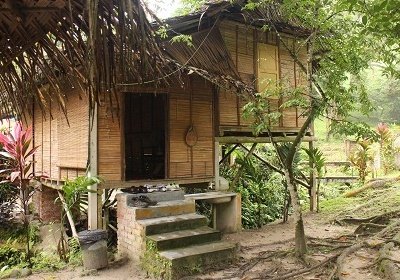
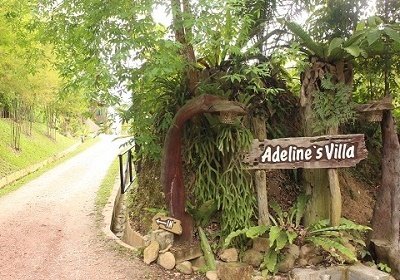
The programme package included all meals and one night’s accommodation at Rumah Rehat Adeline, also known as Adeline’s Rest House. The accommodation consisted of simple non-air-conditioned huts with mattresses on the floor and shared toilets. One of my “atas” friends, Mr Ray, was so horrified by the simplicity of the hut that he coaxed the rest of us into upgrading to better accommodation. We eventually ended up staying at Adeline’s Villa, which offered chalet-style accommodation with air-conditioning, queen-size beds and attached toilets. Both Adeline’s Rest House and Adeline’s Villa were owned and operated by the same owner, Adeline Kuo. However, the Rest House and Villa compounds were not connected and were located a few hundred metres apart.
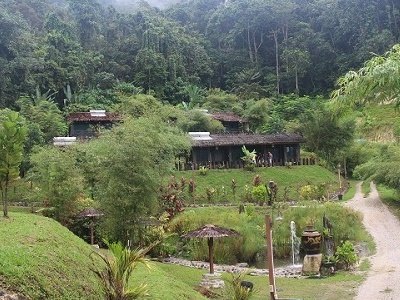
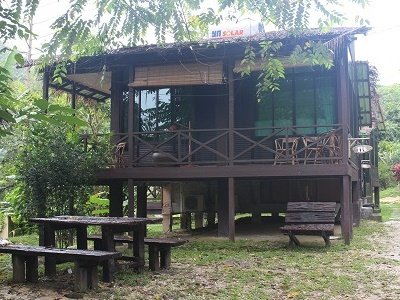
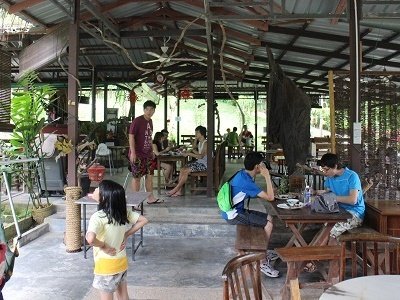
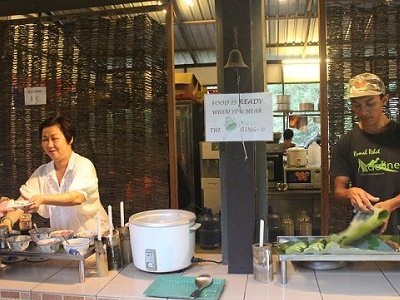
We had a sumptuous buffet lunch at the Villa’s open-air canteen. There were cut fruits, ice kacang, homemade grass jelly drinks, nasi padang, special bamboo soup, goreng pisang and various other finger foods. We ate like gluttons even though we knew that we should not be eating so much before engaging in strenuous activities. After lunch, we rested for about an hour before commencing our activities at around 2 pm.
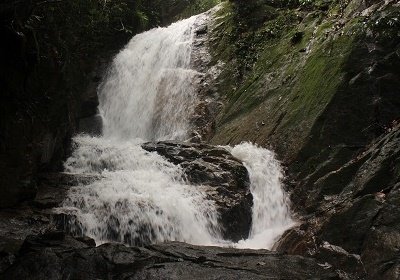
We attempted waterfall abseiling at the 15 m-high Ulu Geruntum Waterfall, situated about 5 km away from Adeline’s Villa. The actual abseiling height was about 10 m, roughly equivalent to the height of a three-storey building. The briefing session, which covered the abseiling equipment, techniques and safety procedures, was conducted on the spot and completed within about 15 minutes. It was more or less a crash course.
We had to abseil down the waterfall without direct assistance, using mainly our legs to support ourselves against the rock face. The only protection we had was our safety helmets and two lifelines that passed through the carabiners attached to our safety harnesses. One of the lines was the abseiling rope, which was attached to a fixed anchor point at the top of the waterfall. The other was a safety line controlled by the instructor, without which we could potentially fall straight to the bottom if we slipped off the rock face. Mr Ray carelessly slipped off the wall during his attempt and immediately decided to give up. I, on the other hand, abseiled from the top to the bottom three times.
After the abseiling, we headed straight to the Kampar River for white-water rafting. The river, incidentally, was not white at all but rather brown in colour. The total rafting distance was about 7 km, with nine rapids along the way. It took us almost two hours to complete the river course. While Sungai Kampar is certainly not comparable to the high-volume rivers of Nepal or New Zealand, it still offered enough of an adrenaline rush for us. The Kampar River is generally rated between Grade 1 and Grade 3 on the International Scale of River Difficulty. The difficulty of the river can vary according to the water level and flow, which in turn depend heavily on the amount of rainfall within its catchment area. We were lucky enough to raft on a day when the river conditions were apparently close to Grade 3.
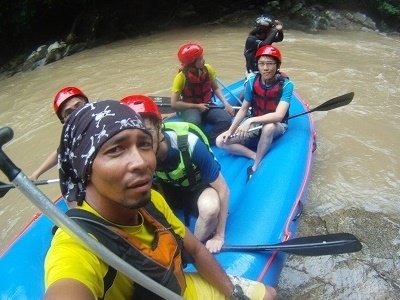
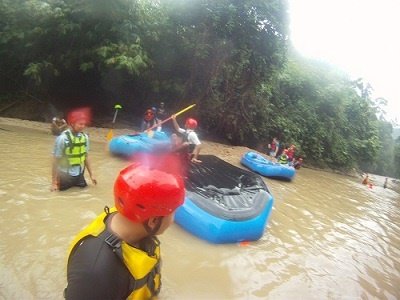
During the rafting, the instructor would call out various commands that we had to react to immediately. Basically, we paddled when the route was clear, ducked into the raft while approaching steeper rapids, and “jumped” by bouncing our butts against the raft whenever the raft became stuck against rocks or other obstacles. It was almost idiot-proof, but you could still easily fall out of the raft, especially if you reacted too slowly to the instructor’s command to duck. All of us fell out of the raft at least once, and our raft even turned turtle on one occasion. The water was not particularly deep in most places, reaching only about chest level at the deeper sections that we encountered.

It was already around 6 pm by the time we completed the rafting activity. We rushed back for a quick shower, full of anticipation for a sumptuous BBQ dinner, only to be greeted by cold food instead. After dinner, there was not much to do except chit-chat and wait for supper.
Supper consisted of red bean soup, banana cake and durians. What a weird combination! We used a simple but ingenious homemade tool, something like a hinged device with two handles, to pry open the durians. There were many wild durian trees growing in the surrounding forests. During the durian harvest season, the Orang Asli living around the area would collect the fallen fruits and sell them to people in town.
Day 2: Cave Exploration
We were privileged enough to be served breakfast by Adeline herself, the owner of Adeline’s Villa. From the way Adeline operated her Villa, with chalet-style accommodation, delicious free-flow buffets and four meals a day, including supper, all at relatively affordable rates, we could tell that she seemed to be doing it as much out of passion as for money. She reminded me of Ivy Singh of Bollywood Veggies in Singapore.

We went to Gua Tempurung, located about 5 km away from Gopeng, for our cave exploration. Initially, I had expected the cave exploration to be much less interesting compared with the abseiling and rafting. In fact, I thought it might be more of a tourist trap than anything else. I was proven wrong. It was one of the best cave complexes I had ever visited!

The total length of the cave is more than 3 km, although only part of it is normally accessible to the public. The cave contains a long underground river and several enormous caverns, some reaching impressive heights. Interestingly, the cave was managed by a private operator, and visitors had to sign up for one of several available tours to explore different sections of the cave. We took the longest option, known as the Grand Tour, which involved a complete circuit from the cave entrance through the giant caverns and underground river before eventually emerging again. The Grand Tour took us more than three hours to complete and cost only RM22 per person at that time.


The first half of the cave trail was dry, as this section was situated above the underground river. It had been developed as a show cave with artificial lighting, proper walkways and staircases. The level of lighting was just right, revealing the sheer size and details of the cavern while still preserving much of its natural mystique, The cave had also been used for tin mining during the heyday of Malaysia’s tin-mining industry. Traces of its mining past could still be seen inside the cave, including some old mining implements and other remnants left behind by earlier miners.

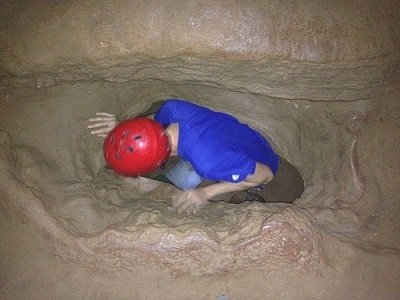
The second half of the cave trail was equally interesting but much more physically demanding. It was pitch-dark deep inside the cave, and all of us had to wear headlamps provided by the cave management to find our way. We performed all sorts of manoeuvres: sliding down slopes, scrambling up slopes, squeezing through narrow crevices, duck-walking beneath low ceilings and even wading through water. Many times, we had to walk directly through the underground river because the riverbanks were either non-existent or too narrow to walk on. The water level varied from ankle-deep to around waist-deep during our visit. According to our guide, during periods of heavy rain, the water level inside certain sections of the cave could rise to above chest level.
It was already around noon by the time we completed the entire cave circuit. We settled our lunch at a small food stall beside the ticketing booth before returning to Adeline’s Villa for a shower and room check-out. Our guide then gave us a ride to Ipoh, where we boarded the Electric Train Service (ETS) to Kuala Lumpur. From Kuala Lumpur, we continued our journey on an overnight KTM train back to Singapore.