Pengerang Battery is a World War Two fort located in Johor, Malaysia. It is situated near the exit of the Tanjung Pengelih immigration checkpoint. Unlike most of the World War Two forts in Singapore, such as Fort Canning, Fort Siloso and Labrador Battery, Pengerang Battery is a completely abandoned site that has never undergone any restoration. Except for the courtyard and cookhouse area, which have been almost completely reclaimed by the forest, most of the structures remain intact despite being exposed to the elements for more than 60 years.
The battery consists of several buildings and structures scattered across an area at least the size of a football field, on top of a small hill overlooking the eastern entrance to the Straits of Johor. These structures include pillboxes, trenches, bunkers, barracks, offices, a cookhouse, toilets and tunnels. However, unlike most of the old forts in Singapore, there are no decommissioned guns, turrets or mounting platforms in sight.
It is believed that before the Japanese occupation of Malaya, the British scrapped or destroyed the coastal defence guns to prevent the Japanese from using them. Contrary to the British belief that the Japanese would invade Singapore by sea, the Japanese invaded by land through the supposedly impenetrable Malayan jungle. Japanese forces under General Yamashita, who was counting on a quick victory because of shortages of manpower and ammunition, bypassed the pockets of resistance at Pengerang Battery and focused their attack on Singapore. Hence, the defence system of armaments and tunnels at Pengerang went through the war without firing a single shot. This was, however, very different from the fate of the £60 million Singapore Naval Base, located just across the Straits, which also saw no action but was partially destroyed by the British at the onset of the war.
We walked along the small road leading away from the immigration checkpoint. The beach was only 10–20 metres from the right side of the road when facing away from the immigration checkpoint. Along the left side of the road was the hillside on top of which lay the remains of the battery. We could not really call it a ruin, as most of the structures were still intact, but “ruin” seemed like a good word to use because it connoted historical value. After walking approximately 50 metres down the road—this was just my own estimate, but it was indeed very near the main gate of the immigration checkpoint—we reached a wooden hut selling food and drinks on the right side of the road. This was where we began climbing the hillside in search of the battery.
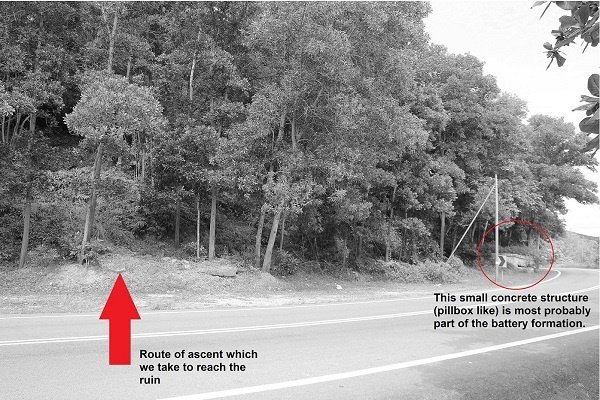
Upon reaching the stall, we were approached by a taxi driver who tried to persuade us to take his taxi to the small town of Sungai Rengit, where most day-trippers go for seafood. We asked him about the location of the battery, and he directed us towards the hillside opposite the stall. He reminded us not to take photographs openly, as the area was near a naval base with sensitive installations, including the radar tower on top of Bukit Pengerang. In fact, we could feel the strong military presence as the bumboat approached the passenger jetty. On the western side of the jetty was Pengerang Naval Base, a recruit training centre for the Royal Malaysian Navy.
Opposite the stall, beside the road, was a small concrete structure that looked like a pillbox. This was probably the first structure belonging to the battery that we saw along the route. Unfortunately, we were all too eager to see the main battery site and forgot to take a photograph of it. During the war, this was perhaps the observation post closest to the beach and would definitely have been the first position to be cleared by the Japanese if there had been a landing operation by sea.
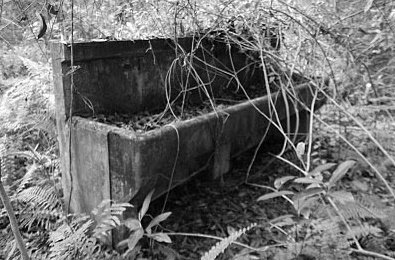
The first structure we encountered on the trail was a large concrete block. It was approximately one metre high and more than an arm’s length long. This was one of the most intriguing structures we found. From its appearance, we could not determine what purpose it had served.
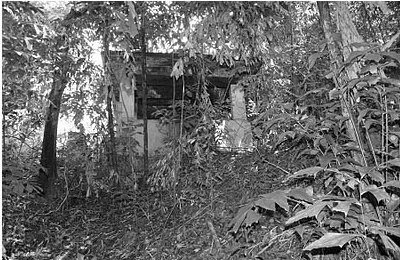
The photo above shows the first pillbox we encountered on the trail. It was very well camouflaged by the surrounding vegetation. There were at least two other similarly sized pillboxes scattered around the site. All the pillboxes were oriented with their firing apertures facing the beach. From inside the pillboxes, you could have a tactical view of the beach below. For those of you who have served National Service in the military, a pillbox is essentially a concrete trench with a low ceiling and a frontal opening through which weapons could be fired. At least the defenders had a roof over their heads and did not need to dig their own trenches.
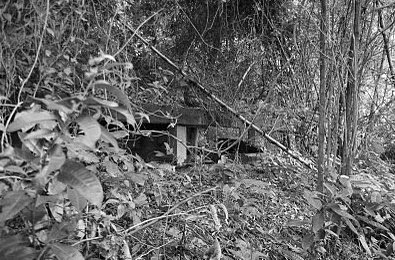
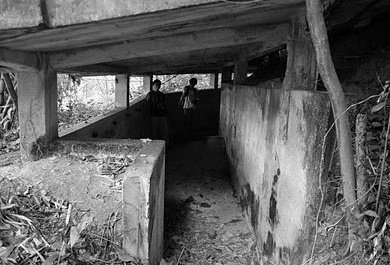
Further uphill, we reached a bunker-like structure with large windows on three sides. Interestingly, there was a very small compartment inside the bunker that could accommodate two standing adults. This small compartment might have been used to store ammunition or food supplies.
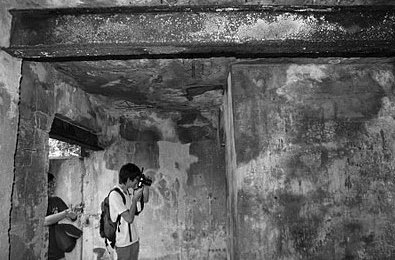
There were exposed horizontal I-beams at the top of the walls. The I-beams were all rusty but still appeared strong enough to support the weight of the concrete roof. There were many wasp nests on the walls and ceiling, although we saw only one or two wasps flying around. The bunker was constructed from reinforced concrete, as steel mesh was exposed in parts of the walls and ceilings. It was perhaps designed to withstand a certain degree of enemy bombardment.
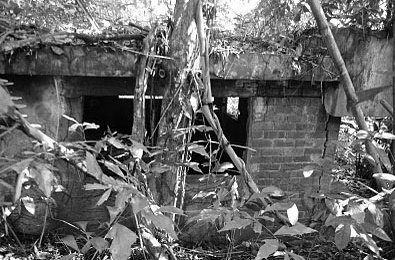
There was a squat toilet a stone’s throw away from the bunker. The toilet did not have a door, but an L-shaped concrete wall in front of it provided some privacy. Further along the route, there was also a row of bathrooms that looked externally similar to the toilet, except that the structure was much longer.
There was another simple structure whose function we could not determine from its nondescript appearance. It consisted of a raised platform—or perhaps simply a flat roof—supported by pillars around its edges. The top was overgrown with vegetation, making the structure so well camouflaged that it could easily have been missed.
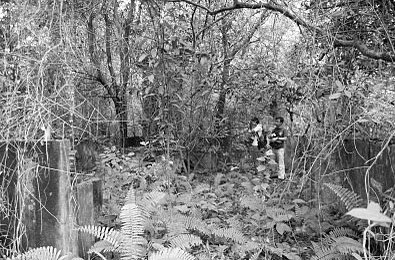
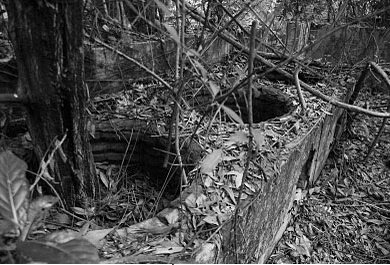
The cookhouse was located in a courtyard. The ground of the courtyard was covered by a layer of soil and overgrown with vegetation. By brushing away the topsoil and grass, we could see the concrete flooring underneath. There was a foxhole, or defensive fighting position, at the back of the courtyard to provide some protection during cooking and mealtimes. The cookhouse was open-air, which made us wonder how its occupants cooked when it rained.
A concrete water-tank tower stood less than 20–30 metres from the courtyard. The tower was approximately two storeys high, perhaps to protect the water supply from sabotage. There was a ladder leading to the top of the water tank, but its lower half had already broken away.
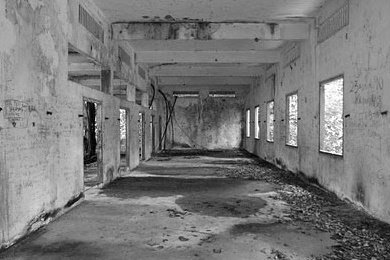

The largest building in the battery was most probably the soldiers’ barracks. It was a one-storey building with a wide corridor, high ceilings and ventilation slits near the top of the walls. There were two bathrooms and a small kitchen in one corner of the building. The building had a strong colonial feel, and its architecture resembled that of the old British barracks in Seletar Camp, Nee Soon Camp and along Changi Road.
Because of the size of the building and the dense surrounding vegetation, I was unable to capture the entire building in a single photograph. Inside the barracks, long tree roots twisted in and out through the windows and ventilation slits, as if nature were reclaiming what had once been its territory. There was a great deal of graffiti on the walls, some of it dating back to the 1970s. There were also some pornographic sketches, which were probably the only drawings I saw in the battery.
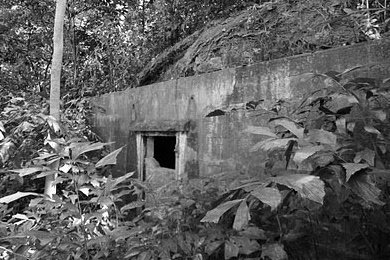
The picture above shows a room built into the hillside. It had only one door and no windows or other openings. The doorway had been partially sealed with a concrete slab. It did not appear to be an ammunition store, as it was not large enough to hold much ammunition. Who knows? It might have been a solitary-confinement cell.
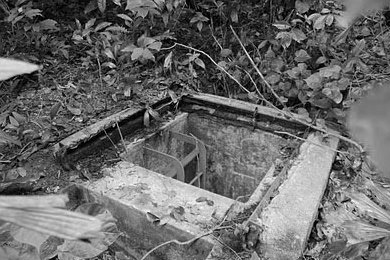
According to an online resource, the battery has an underground engine room. The photo above shows a vertical shaft that might have served as an entrance to or exit from the underground engine room. Apart from this exposed shaft, there were also several well-concealed cylindrical shafts in the surrounding area. These were most probably ventilation shafts that provided fresh air to the underground tunnel system.
How to get there from Singapore
Take a bumboat from Changi Point Ferry Terminal. Two boat services operate from the terminal. One goes to Pulau Ubin, an offshore island of Singapore, while the other goes to Tanjung Pengelih Ferry Terminal in Pengerang.

Submit your passport to the boatman at the counter outside the immigration checkpoint. The boatman will arrange the passports in stacks of 10 to 12 on the counter. When there are enough passengers to fill the boat, usually 10–12 people, the boatman will signal for them to clear immigration and board the boat. Note which stack your passport is in, as the boatman will not call out the passengers’ names.
- Once on board, the boatman will collect the boat fare from you. At the time of writing in January 2012, the fare was S$10 each way. For the return journey, you have to buy your ticket from the boatman at Tanjung Pengelih Ferry Terminal. The bumboat journey takes approximately 50 minutes to 1 hour and 15 minutes, depending on the sea conditions. However, rest assured that the sea is navigable throughout the year.
- Upon reaching Tanjung Pengelih Ferry Terminal, proceed directly to the immigration checkpoint for clearance. The battery is located on a small hill just outside the immigration checkpoint.
Points to take note of
The boat will not depart if there are too few passengers. Therefore, it is advisable to reach the ferry terminal early in the morning, preferably before 8.30 am. Otherwise, you may have to wait longer for the boat to fill up.
To my knowledge, there is no official time for the last bumboat departure from Tanjung Pengelih Ferry Terminal. As on the Singapore side, the boat will depart only when there are enough passengers. However, if you need to return urgently, you can ask the boatman to depart earlier by paying for the empty seats.
Remember to bring your passport if you are travelling from Singapore, as Pengerang is in Malaysia. I have heard of several Singaporeans being turned back at Changi Point Ferry Terminal because they had not brought their passports. It may sound silly, but there really are people who think they can travel to Pengerang without a passport.