Pulau Semakau is located to the south of the main island of Singapore. It was once home to a small fishing village, as was the nearby island of Pulau Sakeng. In 1987, the Singapore Government, after acquiring the land on both islands from the islanders, began relocating them to the mainland. Subsequently, Pulau Sakeng was subsumed into Pulau Semakau through land reclamation, and the combined islands were converted into a landfill.
The Semakau Landfill is Singapore’s first and only offshore landfill. It covers 350 ha (about 440 football fields) and has a landfill capacity of 63 million m³, or a lifespan of 30 years. The landfill is filled mainly with ash produced by Singapore’s four incineration plants, which incinerate the country’s waste. The ash is shipped there every night in a covered barge to prevent it from being blown into the air.
To safeguard the sea against pollution, a 7 km confinement bund surrounds the landfill site, covering part of the sea off Pulau Semakau and the former Pulau Sakeng. This bund is lined with an impermeable membrane and a layer of marine clay to prevent the leakage of leachate, which is wastewater generated within the landfill area.
Today, after years of careful environmental management, the ecosystem of Pulau Semakau is flourishing. Birds can be seen in the air and across the open landscape, fish swim in and out of the lagoons, and marine life continues to thrive in the mangrove mudflats and along the western shoreline of Pulau Semakau.
(Reference articles: http://infopedia.nl.sg/articles/SIP_1008_2010-03-22.html, http://en.wikipedia.org/wiki/Pulau_Semakau)
We joined an intertidal walk on Pulau Semakau organised by the Nature Society (Singapore), or NSS. The meeting time and venue for the tour were 8.00 am at Marina South Pier. From there, we took an hour-long ferry ride to Pulau Semakau. Amazingly, there was a surprisingly large turnout for the tour—by a conservative estimate, at least 50 people of different ages attended.
Upon reaching the Pulau Semakau passenger jetty, the visitors were divided into smaller groups of 10–15 people, with each group guided by an NSS volunteer. We took a three-minute journey by mini-coach to reach the starting point of the intertidal walk. Our coach journey was slightly delayed by a 1.5 m-long monitor lizard sunbathing in the middle of the road. The driver had to stop for a while and wait for it to crawl slowly back into the mangrove swamp.
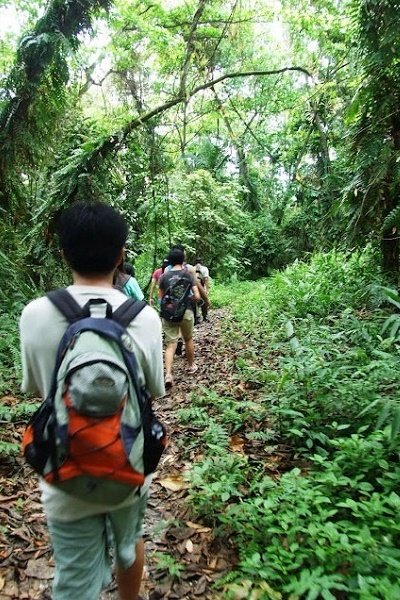
From the trailhead, we embarked on a brief three-minute walk through a secondary forest to reach the beach. The tide was really low at about 0.4 m, with much of the seabed exposed, revealing a maze of marine life and seagrasses that are usually unseen during high tide. We walked for 15–20 minutes out into the sea, and the water level was still well below our knees. The water visibility was good, and we could see the seabed clearly, but we had to move slowly so as not to stir up the sand and cloud the water. Our guide carried a small plastic container to scoop up some marine creatures for the group to view at close range. During the walk, we had close encounters with hairy crabs, flower crabs, starfish, carpet anemones, sea sponges, nudibranchs, stingrays, jellyfish, clams, oysters, mudskippers and even some soft corals.
One mischievous boy threw a small hairy crab onto an anemone, and within seconds, the crab sank into the anemone’s spongy mouth and completely disappeared from sight—it was being consumed. We saw the poor crab trying to claw its way out of the anemone, but it was no match for the anemone’s “quicksand” action.
There was also a cute-looking, translucent, slug-like creature with a pair of horn-like tentacles. It was actually a type of sea slug called a nudibranch. We were advised to wade through the water carefully so as not to step on potentially venomous creatures such as sea urchins, scorpionfish and stingrays. In fact, it is mandatory for all participants in the intertidal walk to wear covered shoes while in the water. At times, one or two jellyfish would swim close past our legs. Besides marine life, we also saw some herons perched on raised mounds above the water, taking advantage of the low tide for a feast. We came out of the water after an hour or so and made our way back to the coach, which took us to the NEA office beside the jetty where we had first arrived.
At the NEA office, we were directed to a lecture room to watch a 15-minute documentary that described in detail the development of Semakau Landfill and the importance of waste management and recycling to Singapore’s sustainable growth. The film was followed by a Q&A session between the visitors and one of the NEA staff members. After the session, we boarded the return ferry to mainland Singapore. It was almost 2.00 pm when we arrived back at Marina South Pier.
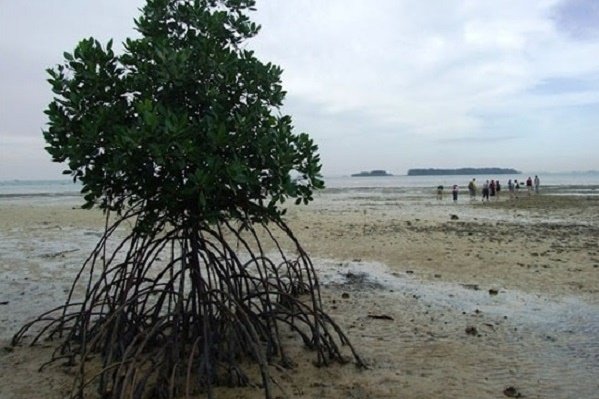
The roots of the mangrove trees are fully submerged during high tide. From the size of the participants in the background, you can imagine how much the water had receded during low tide. Mangrove trees have many uses, including the production of charcoal, scaffolding wood and tannin used in dyes, leather preservatives and furniture stains.
We encountered several species of crabs during the walk. One had a left pincer that was much larger than its right. Have you ever wondered why crabs walk sideways? We also saw hairy crabs, although these were not the same hairy crabs commonly served in Chinese restaurants. Other species included the common flower crab and mud crab—the smaller cousin of the Sri Lankan crab commonly used in chilli crab, one of Singapore’s favourite dishes. (Why do crabs walk sideways?)
Do you know that 98% of a jellyfish’s body mass is water? That is why it looks so transparent. We saw many of them, and they really looked like plastic bags drifting in the water. During jellyfish season, much of the coastal area will be “flooded” by swarms of jellyfish swept in by the incoming tides.
This innocuous-looking organism is a voracious predator, stinging and killing anything—fish, crabs and starfish—that gets too close to its sticky tentacles. Interestingly, anemones form a symbiotic alliance with clownfish, which are protected by a layer of mucus that makes them immune to the anemone’s sting. Clownfish live among the anemone’s tentacles, where they receive protection from predators, while the anemone snacks on scraps from the clownfish’s meals.
Corals are interesting animals that derive most of their nutrients from the by-products of photosynthesis produced by algae living within their tissues. They also have venomous tentacles that they use to catch zooplankton and even small fish.
Generally, there are two main types of corals—hard and soft. Hard corals have six tentacles, or multiples of six, while soft corals have eight tentacles around their mouths. Hard corals have solid skeletons, which are left behind after the corals die. These skeletons are sometimes artificially coloured and sold in shops. Soft corals do not have hard skeletons.
Coral reefs are underwater structures made from calcium carbonate secreted by corals. Some reefs are so large that they form islands, such as the Maldives. Do you know that there are also coral reefs in the seas around Singapore? (http://coralreef.nus.edu.sg/)
The foot is almost as hard as the shell—one big lump of muscle. We also saw the common cockle (“hum” in Hokkien) and chut chut, a type of conical shellfish. Both are popular dishes found in zi char stalls.
Do not mistake it for a bunch of dead twigs and leaves. It is actually the “house” of a solitary tube worm. The solitary tube worm makes a tube about 1 cm in diameter. The portion that sticks out of the mud is reinforced with scraps of twigs, dead leaves and, sometimes, shells. You can actually buy them from some fishing tackle shops in Singapore. They are excellent bait, and unlike live prawns, they do not require a portable air pump to keep them alive while fishing. You need to squeeze the worm out of its tube before using it as bait.
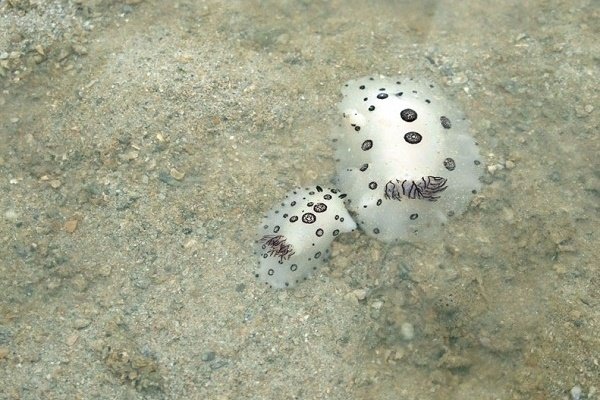
The nudibranch belongs to the sea slug family. Nudibranchs have some of the most fascinating shapes, vivid colours and intricate patterns of any animal on Earth. (http://www.sergeyphoto.com/underwater/nudibranchs.html)
Although they may look plant-like, sponges are the simplest multicellular animals. They attach themselves permanently to an anchorage and move seawater through their bodies, filtering out bacteria, plankton and other organic particles for food. Interestingly, before synthetic sponges were invented, natural sponges were harvested by divers for use as household cleaning tools.
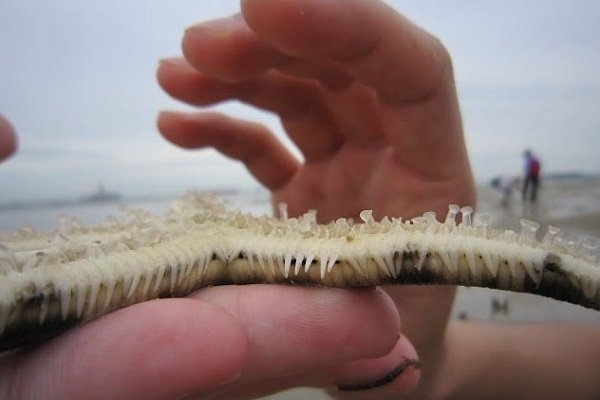
Starfish are famous for their ability to regenerate their limbs and, in some cases, their entire bodies. Some require the central body to remain intact in order to regenerate, but a few species can grow an entirely new sea star from just a portion of a severed limb.
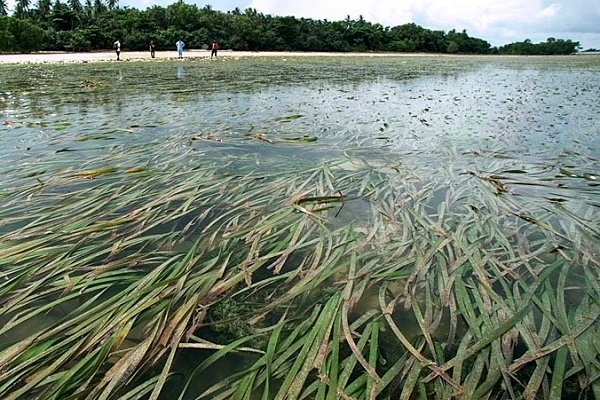
One of the highlights of this trip was actually the seagrass. Seagrasses are the only flowering plants adapted to grow while submerged in the sea. On the seabed around Pulau Semakau are vast tracts of seagrass stretching for kilometres. Seagrass meadows on the seabed are similar to rainforests on land: they provide shelter and food—indirectly through the algae growing on them—for marine organisms. Seagrasses also provide places for animals to lay their eggs and hide from predators. Few animals eat seagrass because the cellulose in the plants is not easily digestible. However, it is the main food of the dugong, also known as the sea cow. Yes, there are dugongs in Singapore’s waters. There is even a group of volunteers from Seagrass-Watch who conduct regular seagrass assessment and monitoring programmes along Singapore’s shores. (http://www.seagrasswatch.org/Singapore.html, http://teamseagrass.blogspot.com/)
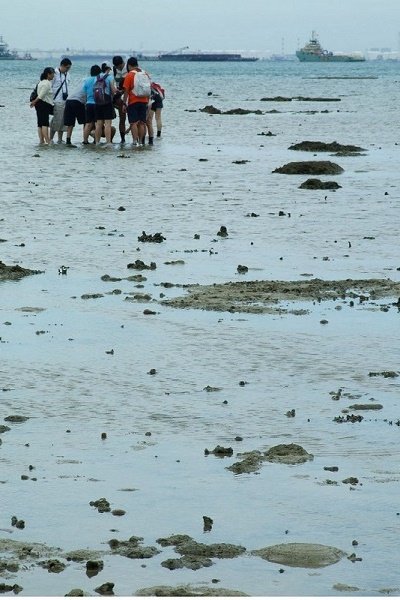
To the north of Pulau Semakau, less than 2 km away, is Pulau Bukom, the site of Shell’s largest oil refinery in the world, with a crude distillation capacity of 500,000 barrels per day. Just beside Pulau Bukom are Pulau Ular, home to the Shell Ethylene Cracker Complex, and Pulau Busing, home to the Tankstore oil and chemical storage complex. These three islands—Bukom, Ular and Busing—are now joined together by land reclamation. This is truly a testament to excellent environmental management, where ecosystems and industrial activities can coexist in such close proximity.
The walkway is lined with Casuarina trees. Coastal trees such as Sea Hibiscus and Casuarina were planted on the island by the National Environment Agency (NEA). To replace some of the mangroves lost during land reclamation, the NEA also planted 400,000 mangrove saplings on 14 ha of specially created mudbeds in 1998. The mangroves are thriving, and they serve as a biological indicator, providing an early warning if toxins leak into the sea.
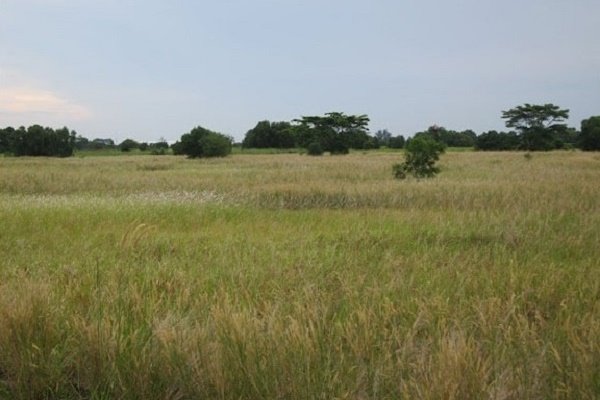
According to one of the NEA staff members, Pulau Semakau is open to the public for wedding photo shoots. So far, at least one wedding couple has had their photographs taken on Pulau Semakau. It is not a bad idea if your fiancée insists on an overseas photo shoot. Just take an hour-long ferry ride, and here you are. =)
Location of Pulau Semakau
Pulau Semakau is located 8 km south of Singapore.
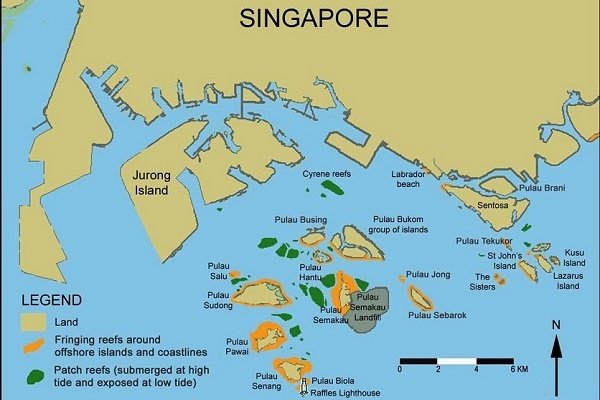
How to Get There
As of now, Pulau Semakau is accessible only through activities conducted by designated interest groups.
- TeamSeagrass conducts regular surveys of the seagrasses on Pulau Semakau. Anyone may join TeamSeagrass as a volunteer: http://teamseagrass.blogspot.com/
- Intertidal walks or birdwatching with the Nature Society (Singapore): http://www.nss.org.sg/
- Sport fishing with the Sport Fishing Association (Singapore).
- Stargazing with the Astronomical Society of Singapore: http://www.tasos.org.sg/
Relevant Links
Leave a Reply