Day 01
A week before our Flores trip, Mount Rinjani, located just across the straits from Bali, erupted and caused flight diversions and the closure of Bali airport. The situation did not look optimistic, and we thought we might have to cancel our holiday again. Fortunately, just one day before our trip, the volcanic activity subsided, Bali airport reopened and our flight to Flores resumed. We happily boarded the plane without giving too much thought to whether it was really safe to fly so close to an erupting volcano.
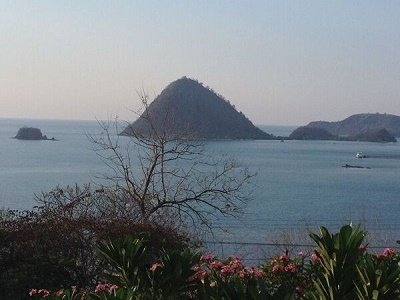
We flew from Singapore to Labuan Bajo with a transit in Bali on Garuda Indonesia. The flight from Bali to Labuan Bajo took about 1 hour 30 minutes. For such a short flight, we were expecting a small propeller plane, but to our disappointment, it was a jet instead. The plane cruised at a relatively low altitude throughout the flight, and we could see dozens of pretty little uninhabited islands and even a few volcanic peaks, including the smoking Rinjani, through the window. Komodo Airport in Labuan Bajo was a very small airport, with only one or two planes on the tarmac, giving us the impression that we were really in for some outback experience. To our amazement, there was even a taxi booth inside the airport with a list of fares to the various hotels in town. The fare to Golo Hilltop Hotel was 60K IDR per vehicle. It seemed quite expensive considering that it was only a 10-minute drive to the hotel. Nevertheless, we took the cab without much complaint because we knew it was at least a “wholesale” rip-off rather than the tout-style rip-offs we had experienced plenty of times in Bali. The driver spoke reasonably good English and was very friendly. He even stopped along the way to let us take some photos of the scenery. Golo Hilltop Hotel, run by two friendly Dutch ladies, was about a 10-minute walk from the town centre, but its location on top of a hill overlooking a tranquil and scenic bay more than made up for the slight inconvenience. The room was very clean, with air-conditioning and a reliable hot shower—something most Singaporeans probably cannot do without.
We went into town to look for tour packages to Cunca Wulang Canyon and Komodo/Rinca Island. The prices offered by the various agencies were more or less competitive, but there was really no way of knowing their quality and reliability until we tried them. After asking around for more than an hour, we finally settled on one agency based on traveller’s intuition and perhaps a little physiognomy—although this method had proven us wrong many times before. 🙂 For dinner, we patronised the number-one restaurant on TripAdvisor at the time, Sushi Banana. We ordered a maki roll and a bento for only 230K IDR. It was surprisingly good and refreshing considering where we were. After dinner, we took a private taxi back to the hotel for 40K IDR.
Day 02
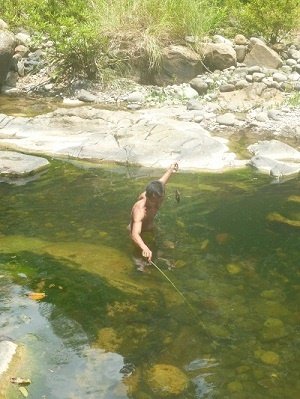
The agency driver picked us up from the hotel at around 7 am. It was about a 1-hour 30-minute drive from our hotel to Wersawe Village, where the trailhead for the trek was located. There was an official booth at the trailhead where we paid for the hiking permit. We also hired one of the villagers, who could not speak any English, as our trekking guide. The trek to the canyon took about 45 minutes over relatively flat terrain. At the river, we saw two villagers catching fish in waist-deep water. Their fishing tackle consisted of a long, thin and flexible grass stalk, which served as the fishing rod, with a small string loop attached to one end. No bait was used at all. When an unsuspecting fish swam into the loop, the angler would flick the rod upwards, trapping the fish inside it. It was an ingenious but painstakingly slow method of fishing.
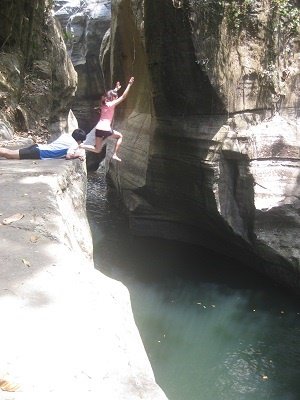
We climbed to the top of the canyon, about 10 metres above the water. The canyon was famous for cliff diving, and one of us jumped straight from the edge into the water below. Instead of attempting this daredevil act, I entered the river from another side of the canyon where the water met the bank. Yes, I am a scaredy-cat. We swam towards the plunge pool of the waterfall and enjoyed a natural jacuzzi massage beneath the falling water. The waterfall itself was not particularly impressive, but the beautiful surroundings and the nice cooling swim more than made up for it.
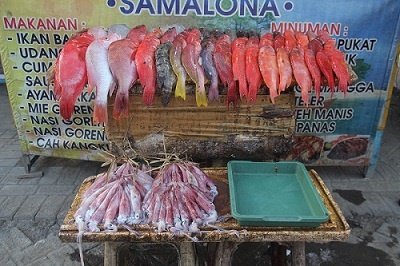
In the evening, we walked from our hotel to the waterfront in town. There were many street-food stalls selling BBQ seafood, with their fresh catches laid out in front. A decent-sized red snapper weighing about 400g cost around 50K IDR. We ordered a BBQ red snapper, calamari, sambal kangkong and two large bowls of bakso noodle soup. It was quite an authentic local dining experience, as most of the diners were locals. After dinner, we went to the minimart across the road to buy our dessert—Magnum ice cream. It was exactly the same Magnum that we get in Singapore, but at half the price! Along the way back to our hotel, we saw a very bright shooting star streak across the sky.
Day 03
Komodo National Park consists of the three main islands of Komodo, Rinca and Padar, together with numerous smaller islands. The highlight of the park is, of course, the Komodo dragon—the largest living species of lizard in the world. A fully grown dragon can weigh around 70kg and grow to between 2 and 3 metres long. The Komodo dragon is endemic to this part of Indonesia, which means it is not naturally found anywhere else in the world. Komodo and Rinca Islands were among the best places in the park to see the dragons. We signed up for a private tour that combined a visit to Rinca Island with snorkelling at Kelor Island and flying-fox watching at Kalong Island.
The tour agency picked us up from the hotel and brought us to the boat pier at around 8 am. The boat was a simple wooden vessel with passenger seats at the front and a toilet at the back. The crew consisted of our tour guide, Nei Gui, the boat captain and his assistant. To our astonishment, there were no life jackets on board, even though Nei Gui had told us earlier that they would be provided. He apologised for the oversight and tried to assure us that the boat journey would still be safe without them. We refused to set sail without life jackets because we had heard of too many tragic boat accidents around the Komodo region. The captain moved the boat to a quiet corner of the pier and climbed aboard a group of anchored boats. He disappeared for about 20 minutes before returning with several life jackets. Apparently, he had “borrowed” them from some other boats. About 30 minutes into the journey, we suddenly saw something jump out of the water. It was a small group of two or three dolphins. We were exhilarated because they appeared very close to our boat, and we certainly had not expected to encounter dolphins so near the mainland.
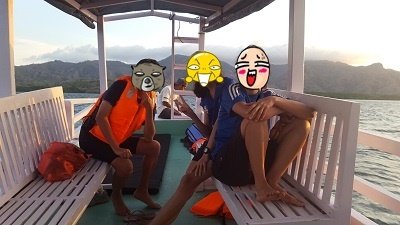
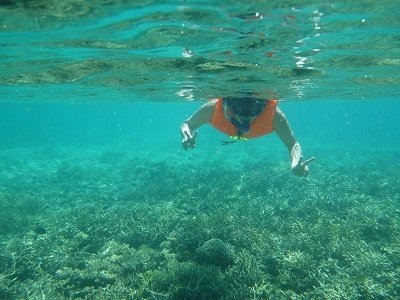
Kelor Island, about 1½ hours by boat from Labuan Bajo, was a very small uninhabited island with a hill overlooking the surrounding scenery. There was a small trail leading to the top of the hill, although we did not climb it. The waters around Kelor Island were very clear and shallow and teeming with fish and live corals. We had to keep ourselves afloat constantly so that we would not step on the corals. The moment I accidentally touched one with my foot, I felt a slight sense of guilt and suddenly wondered whether there was really such a thing as ecotourism. Once we enter an ecosystem, we are bound to affect at least some part of it, no matter how careful we try to be. We saw many colourful reef creatures, including clownfish, nudibranchs, sea urchins and starfish. Interestingly, the shallow water suddenly gave way to a deep underwater trench only about 20 metres from shore.
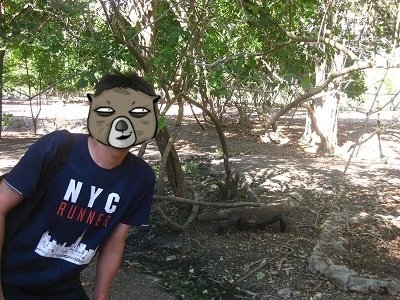
There were four different permits or entrance fees that we had to pay in order to see the dragons on Rinca Island: an entrance fee, a trekking permit, a wildlife observation permit and a trail permit. It was quite an amusing system. Perhaps they should have simplified things by combining everything into one or two fees. There were three hiking routes in the park: short, about 45 minutes; medium, about 1½ hours; and long, about three hours. We chose the medium hike, hoping that the longer route would give us a better chance of seeing wildlife. It turned out not to be such a good decision. The weather was extremely dry and scorching hot, and there was hardly any shelter along the trail. We did not see many animals apart from two or three dragons, a deer and some animal skulls. Back near the national park office, we saw a group of lethargic dragons lazing underneath the huts. They did not look as menacing as I had imagined, probably because they were less active during the heat of midday.
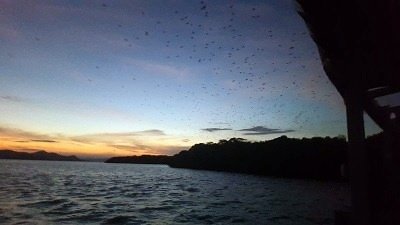
Next, we sailed towards Kalong Island to see the flying foxes. We arrived too early, so the boat dropped anchor while we waited for the sun to set and the bats to emerge. Shortly after 7 pm, we began seeing what looked like bird-like creatures flying out of the mangrove swamp. More and more appeared until the sky was filled with tens of thousands of them. From a distance, they looked more like birds than bats. When some flew directly overhead, however, we could clearly make out the skeletal structure of their outstretched wings. Interestingly, there was hardly any screeching despite there being thousands of them in the sky. They were heading towards Labuan Bajo, about 16km away, in search of food. Imagine having to travel so far just to look for dinner every day. 🙂 It was truly an amazing sight, provided you did not mind the possibility of guano dropping from the sky.
Day 04
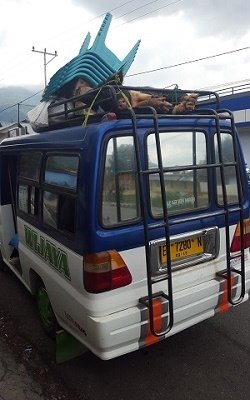
We took a public bus from Labuan Bajo to Bajawa, with a transit stop in Ruteng. It took us more than 10 hours to reach Bajawa, including a two-hour lunch stop in Ruteng. The bus was non-air-conditioned and packed with passengers and their belongings. There was even a motorcycle strapped to the back. According to the driver, goats and chickens sometimes travelled on board as well. We were actually quite impressed by the road conditions in Flores. The roads were generally well maintained, with very few potholes. Nevertheless, it was still a bumpy and winding journey as the roads snaked through mountainous terrain. The bus would stop at villages along the way to drop off and pick up passengers.
In Ruteng, we went to one of the better-known restaurants in town, Rumah Makan Chacha, for lunch. The owners, Johan and Yayuk, spoke very fluent English and were extremely friendly. We learnt from them that most of the ingredients used in their dishes were sourced from their family farms. On the way back to the bus station, we walked past a school where classes had just ended for the day. Some of the students smiled and said hello to us, while others ran away giggling as we walked past. For a moment, we felt like instant celebrities. Some of the older boys, however, tried to maintain an air of nonchalance, complete with heavily gelled hair, untucked shirts and model-like poses. They reminded us of a miniature version of the Backstreet Boys. The public bus eventually dropped us at a bus stop on the edge of Bajawa town. We called the resort reception, and they sent a driver to pick us up. From there, it was another fairly long drive of about 30 minutes to the foot of Mount Inerie, where Manulalu Resort was located.
Day 05
We woke early in the morning, not to the sound of singing birds, but to the loud buzzing of cicadas. It was like having an incessantly noisy alarm clock with no snooze button. We found them everywhere around the resort, and some even “sneaked” into our bedrooms, causing mass hysteria among the girls. Our guide tried to allay their fears by catching one and holding it between his lips. He told us that when he was a child, he used to eat them as TV snacks! Along the trail to the surrounding villages, we saw many interesting crop plants, including candlenuts, cashew nuts, cloves, coffee, cacao and cotton. The most interesting and funny-looking crop was probably the cashew plant. Its nut actually grows outside the fruit. The fruit, known as the cashew apple, is edible and is eaten in various parts of the world.
The area around Bajawa is inhabited by the Ngada people, who speak their own Ngada language and practise Catholicism mixed with elements of traditional animist beliefs. Unlike communities in some other parts of Flores, traditional Ngada society follows a matrilineal system in which family property and inheritance are passed through the female line. We visited the traditional villages of Luba, Bena, Tololela and Gurusina, which are known for their distinctive architecture. The villages generally consist of two parallel rows of tall, thatched-roof houses where the families live. Between the two rows of houses are pairs of traditional shrines known as ngadhu and bhaga, representing the male and female ancestors of each clan. The ngadhu, symbolising the male ancestors, resembles an umbrella-like structure and is crowned with a human figurine holding a parang in one hand and a spear in the other. The bhaga, representing the female ancestors, resembles a small house with a thatched roof. Apart from the ngadhu and bhaga, there are also megalithic structures used in traditional rituals and to maintain a connection with the ancestors and the supernatural world. Another interesting feature of these villages was the presence of large Catholic tombs in the middle of the village squares. Some probably belonged to important members of the clans or villages. Outside one village, we saw a group of locals working together to build a school for the children.
Instead of charging a fixed entrance fee, each village had a donation box where visitors were encouraged to make a contribution. Although the villages were already well-known tourist attractions, we did not encounter any touts, and the villagers selling handicrafts were not pushy at all. There was even a prominent sign at the village entrance reminding visitors not to give gifts directly to children without their parents’ consent. This, to us, was sustainable tourism done properly.
After visiting the villages, we went to Malanage Hot Spring to soothe our aching muscles. The river consisted of two streams—one hot and one cold—which merged downstream to form a wider river. By positioning ourselves at different spots, we could more or less adjust the water temperature naturally. We met a group of friendly Basques who helped us cross to the other side of the river. I asked one of them whether he was from Spain. Without hesitation, he replied that they were Basque and regarded the Basque Country as different from Spain, with its own distinct language and identity.
Day 06
We set off from the hotel at 4 am for our Mount Inerie trek. Inerie is pronounced something like “inner ear”, which made the name rather easy to remember. It was about a 20-minute drive from the resort to the trailhead at Watumeze Village, at approximately 1,100 metres above sea level. The first 30 minutes of the trek were over relatively flat terrain with plenty of tree cover. After that, we emerged above the tree line and saw Inerie’s peak looming ahead of us beneath the starry sky. There were very few trees from that point onwards, with most of the vegetation consisting of grass and shrubs. From there, it was a steep uphill climb almost all the way to the crater rim.
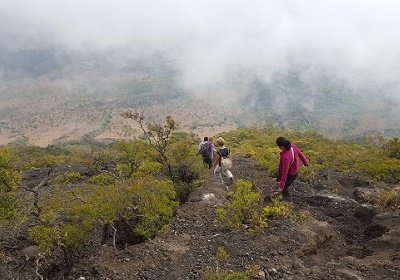
The distant mountains and meadows slowly revealed themselves as daylight crept over the horizon. In the distance, we saw the beautiful conical shape of Mount Ebulobo. It looked extremely steep, and we were relieved that we had not chosen to climb it. Our guide then promptly informed us that Inerie was actually even steeper. It took us about three hours to reach the first peak. From there, the trail towards the second peak, which was the summit, looked incredibly steep and precarious. The final push took about 45 minutes. We were essentially trekking along the crater rim towards the summit, although strangely, the route did not feel quite as steep as it had looked from below. The crater itself looked like a huge abyss and loomed menacingly beside us as we followed the narrow trail. The summit consisted of a small patch of relatively flat ground with a flagpole and an Indonesian flag.
After taking in the views, we trekked back to the first peak. From there, we took another route down the mountain—the so-called “fast lane”. It consisted of a long scree-covered slope running from high up the mountain towards its middle section. The loose rocks, pebbles and sand made the slope extremely slippery, and we practically skidded our way down, adjusting the angle of our feet to control our speed. It was quite fun at first, but after a while we became tired of the hot sun, the endless sliding and all the sand and stones getting inside our shoes. After completing the fast lane, we rejoined the same route that we had used for the climb. It took us almost three hours to get back to the trailhead from the summit. The rest of the day was spent in bed resting our very sore muscles. 🙂
Day 07
We took public transport to Moni, the last destination of our trip. We set off at around 8 am and reached Moni at about 2 pm. The bus did not drop us directly outside Kelimutu Eco Lodge, so we had to haul our luggage along the road to the lodge ourselves. After checking in and having a quick late lunch, we arranged for a driver to take us to Kelimutu National Park.
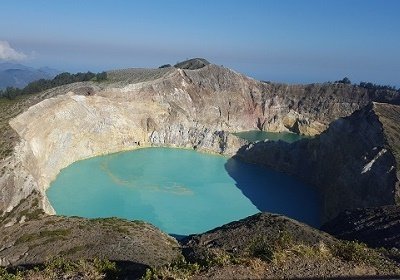
Kelimutu is a volcanic complex famous for its three striking crater lakes, which can display different colours. Tiwu Ata Bupu, commonly translated as the Lake of Old People, is the westernmost lake. The other two lakes, Tiwu Ko’o Fai Nuwa Muri and Tiwu Ata Polo, are separated by a shared crater wall. The colours of the lakes have changed many times over the years, which is one of the features that makes Kelimutu so unusual. Proper pathways and railings had been installed around the national park viewing areas. The scenery was still top-notch, although the man-made structures did take away some of the rugged feel of the place.
The park was very quiet, with only a handful of visitors around. Most tourists visit Kelimutu early in the morning to watch the sunrise rather than in the afternoon. Unfortunately, we could not make it for the famous sunrise view because we had to catch our flight back to Bali the following day. There was also a road-widening project underway, and the road leading from Kelimutu towards the airport was being closed for several hours during the day, which made the timing even more difficult.