I created a simple aquaponics system at home using my 2-foot fish tank, where I keep several African cichlids. After reading some online tutorials and watching YouTube videos, I figured that the easiest option for my existing setup was a timed flood-and-drain system rather than using a bell siphon. I chose the timed system mainly because it is simpler and more predictable. Since I am usually at work during the day, I wanted something that could be left unattended with less risk of the siphon failing to start or stop properly.
First of all, I gathered the materials I needed:
- 60 × 40 × 30 cm plastic storage tub from TOYOGO or IKEA to use as the grow bed
- LECA (Lightweight Expanded Clay Aggregate) as the grow bed medium – can usually be bought from florist shops
- Small AC submersible water pump, around 400–500 L/h, 5–8 W, with maximum head of about 1 metre – from an aquarium shop
- Mechanical timer switch for switching the water pump on and off – from a DIY or hardware shop
- Bulkhead fitting – from Amazon.com
- PVC pipes of various sizes, together with elbow fittings, tees and valves – from a plumbing hardware shop
- Fish tank stand – from an aquarium shop
- Fluorescent lamps – from a lighting shop
- Wooden wall shelf where the fluorescent lamps can be mounted underneath – from IKEA
- PVC solvent cement for joining the pipes – from a plumbing hardware shop
- Basic hand tools such as a handsaw and electric drill
- Aquarium air pump and air pipe if additional aeration is required
- Seedlings such as Caixin or Xiao Bai Cai
- A separate smaller grow bed or tray for growing seedlings before transferring them to the main aquaponics grow bed
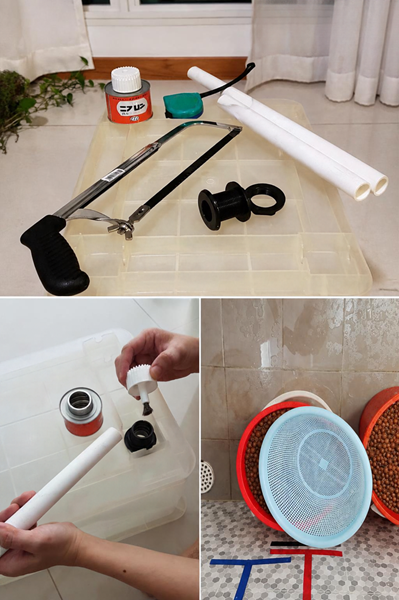
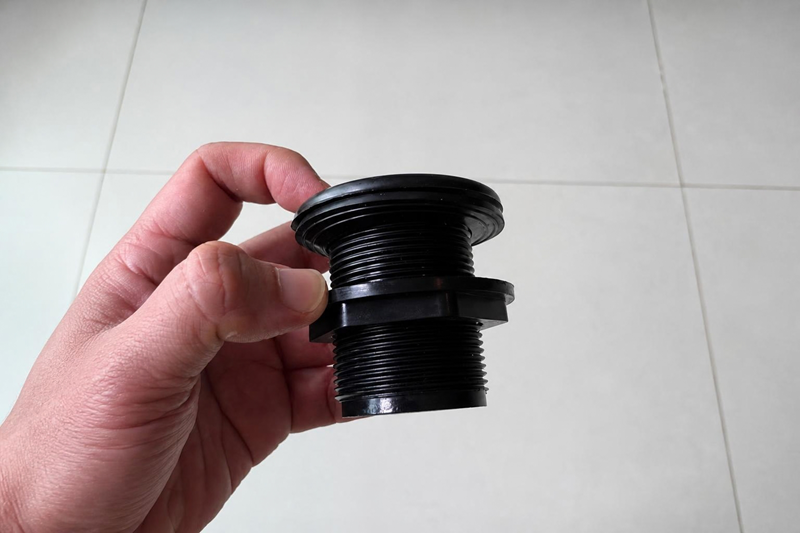
The first thing I did was install a bulkhead fitting at the bottom of the Toyogo container. A bulkhead fitting basically creates a watertight connection through the bottom or side of the grow bed, allowing PVC piping to be connected on both sides. For me, this was actually one of the hardest components to source at that time, although it is probably much easier now. I couldn’t find a suitable one locally, so I eventually ordered several different sizes from Amazon and tested them. In the end, I settled on a 1-inch bulkhead fitting.
Plumbing sizes can be rather confusing for non-experts because some pipes and fittings use metric sizes while others use imperial sizes. To make things even more confusing, the stated pipe size is often only a nominal size and not the actual measured diameter. For example, although 1 inch is 25.4 mm, a 1-inch imperial PVC pipe can have an outside diameter of around 33 mm. To avoid buying the wrong pipe, I actually brought the bulkhead fitting with me to a plumbing hardware shop and physically tried different pipes until I found one that fitted properly.


I then made a standpipe and drilled a number of small holes along the lower section of the pipe. These holes allow water to drain continuously back into the fish tank. When the pump is running, water enters the grow bed faster than it can drain through the holes, so the water level gradually rises. Once the timer switches the pump off, the remaining water drains back into the fish tank through the same holes. The top of the standpipe can also act as an overflow if the water level rises too high. In my actual setup, however, the end of the standpipe was slightly above the rim of the container. Since I wasn’t following any exact design or recipe, getting the drainage right involved some trial and error. I experimented with the number and size of holes until the grow bed filled at a reasonable rate when the pump was running but could still drain almost completely after the pump switched off. After drilling the holes, I used a small file to smoothen the edges on both the inside and outside of the pipe. On the other side of the bulkhead fitting, I connected another PVC pipe which directs the water straight back into the fish tank below. The pipes were connected using PVC solvent cement.
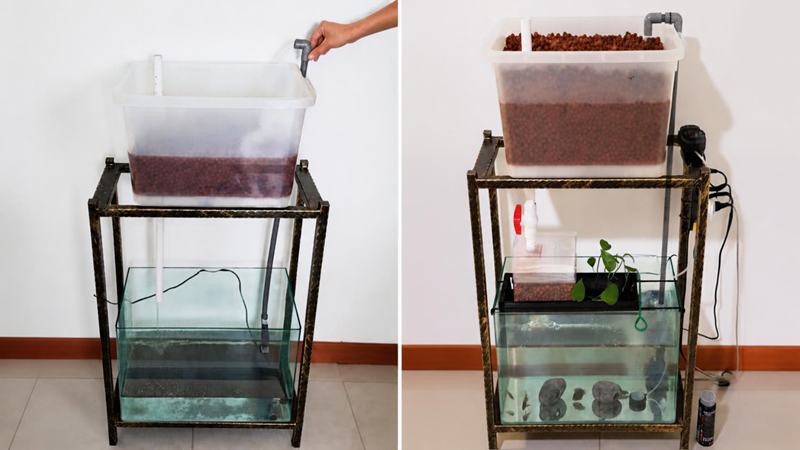

Once the plumbing was completed, I filled the container with LECA beads. Before doing so, I washed the LECA several times to remove the dust, sand and dirty residue. I then placed the water pump at one corner of the fish tank, which in my setup was the rear right-hand corner as seen in the photo. A long PVC pipe was connected from the pump outlet up to the grow bed, with an elbow fitting used to direct the water into the container. The pump was connected to a mechanical timer which I eventually set to run for around 15 minutes and switch off for 45 minutes, with the cycle repeating throughout the day. Again, this was not based on any exact formula. I adjusted the timing by trial and error until the grow bed flooded sufficiently during the pumping period and had enough time to drain before the next cycle.
For the lighting, I assembled a simple wooden wall shelf from IKEA above the grow bed and attached several fluorescent lamps underneath it using Velcro tape. The lamps I used were just ordinary 1- to 2-foot household fluorescent lamps rather than specialised grow lights. Nowadays there are many specialised LED and fluorescent grow lights available which are brighter, more energy efficient and designed with wavelengths that are more suitable for growing plants.

Before planting in the aquaponics system, I first grew the seedlings separately. For vegetables such as Caixin or Xiao Bai Cai, I transferred them when they had developed around three to four true leaves. At this stage, the seedlings are still quite fragile, so they should be removed carefully without pulling on the stem or damaging the fine roots. I made a small opening in the LECA, placed the roots inside and gently covered them to hold the plant upright. The roots should reach the moist zone during the flood cycle, while the stem and base of the leaves remain above the water level to reduce the risk of rotting.

You may also notice a valve and two rectangular boxes filled with LECA at the water outlet, just before the water flows back into the fish tank. The valve is mainly used to throttle or adjust the return flow rate, while the LECA-filled boxes act as a final filter to trap some of the coarser particles before the water returns to the tank. These are actually optional and not really necessary for the system to work.
After transferring the seedlings into the main grow bed, leafy vegetables such as Caixin and Xiao Bai Cai generally need another 3–6 weeks before they are ready for harvest, depending on the variety, light and growing conditions.